
Nvidia introduced DLSS 5, the latest version of its AI graphics technology, during the company’s GTC keynote, where CEO Jensen Huang explained how the new system blends traditional rendering with generative AI to create more realistic game visuals while reducing the amount of compute power required.
The approach allows GPUs to produce detailed environments, lifelike characters, and complex lighting effects without rendering every single pixel from scratch, which helps developers push visual quality further without overwhelming hardware resources.
According to Nvidia, DLSS 5 works by combining structured 3D graphics data with generative AI models that can predict and fill in missing visual information inside a frame. Huang described the concept during the keynote by saying, “We fused controllable 3D graphics, the ground truth of virtual worlds, with generative AI, probabilistic computing,” which reflects Nvidia’s effort to merge deterministic graphics pipelines with AI-driven image generation.
DLSS 5 improves game realism
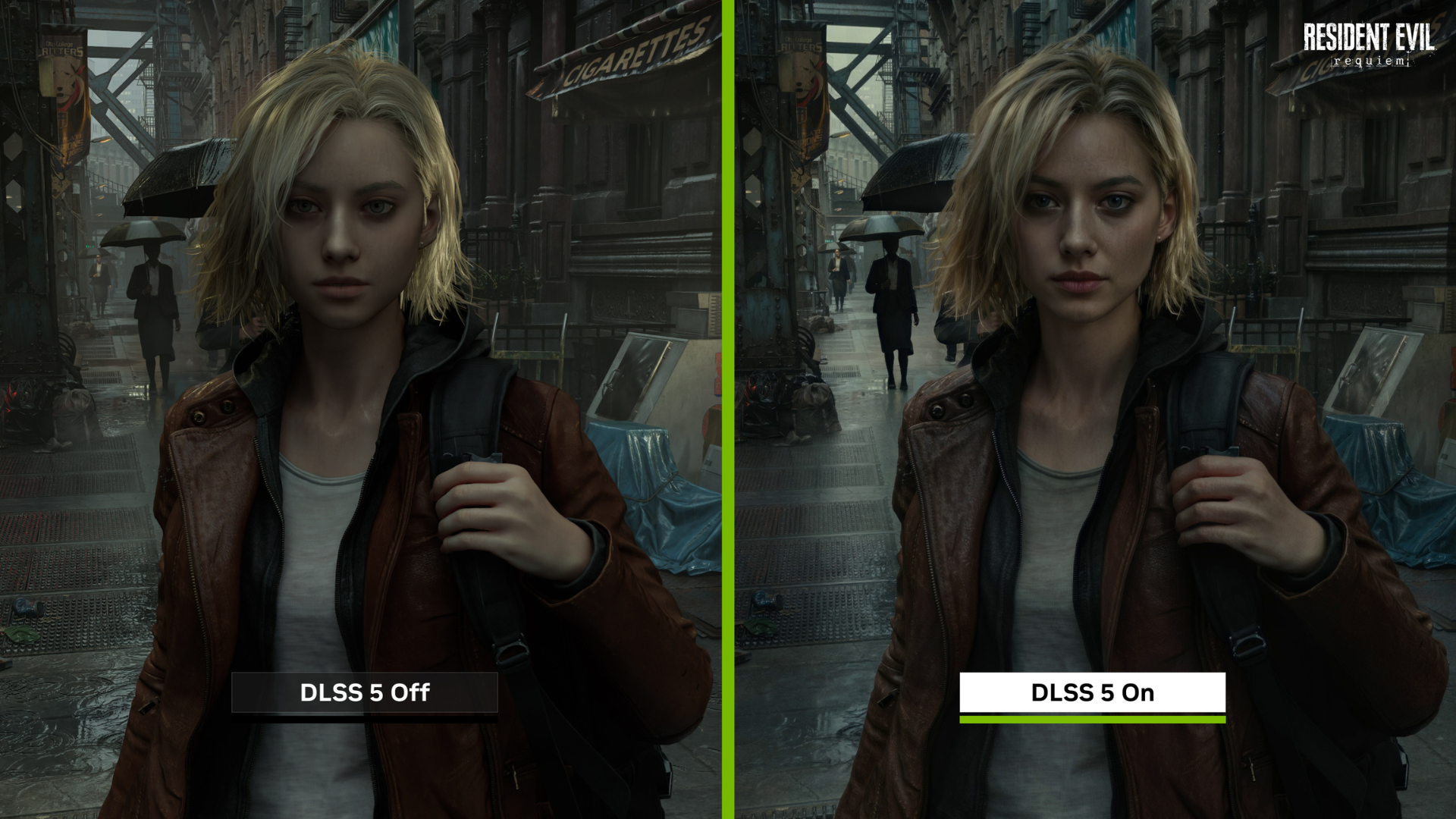
DLSS 5 introduces a real-time neural rendering model that adds photoreal lighting and material properties directly to pixels generated in a frame. The system analyzes color data, motion vectors, and scene structure from the game engine and then enhances the image with lighting behavior, skin shading, fabric reflections, and hair detail that normally require heavy rendering workloads.
The AI model also understands scene semantics such as characters, translucent skin, and lighting conditions like back-lit or overcast environments, which allows it to generate consistent visuals across frames during gameplay.
Developers still maintain artistic control through tools that adjust color grading, intensity, and masking so each game keeps its unique visual style.
Huang also framed DLSS 5 as an example of a broader shift in computing where structured data works together with generative AI systems. He explained that structured datasets form the “foundation of trustworthy AI,” while generative models help analyze and create new outputs based on that data.
For that reason, Nvidia believes the same approach could extend beyond gaming into enterprise software platforms and data systems. Huang noted that future AI agents will rely on both structured databases and generative data systems, which means the same principles powering DLSS 5 in games could influence how AI tools analyze and generate insights across many industries.
DLSS 5 is scheduled to arrive this fall and will appear in upcoming titles from major publishers including Bethesda, Ubisoft, CAPCOM, and Warner Bros. Games.