
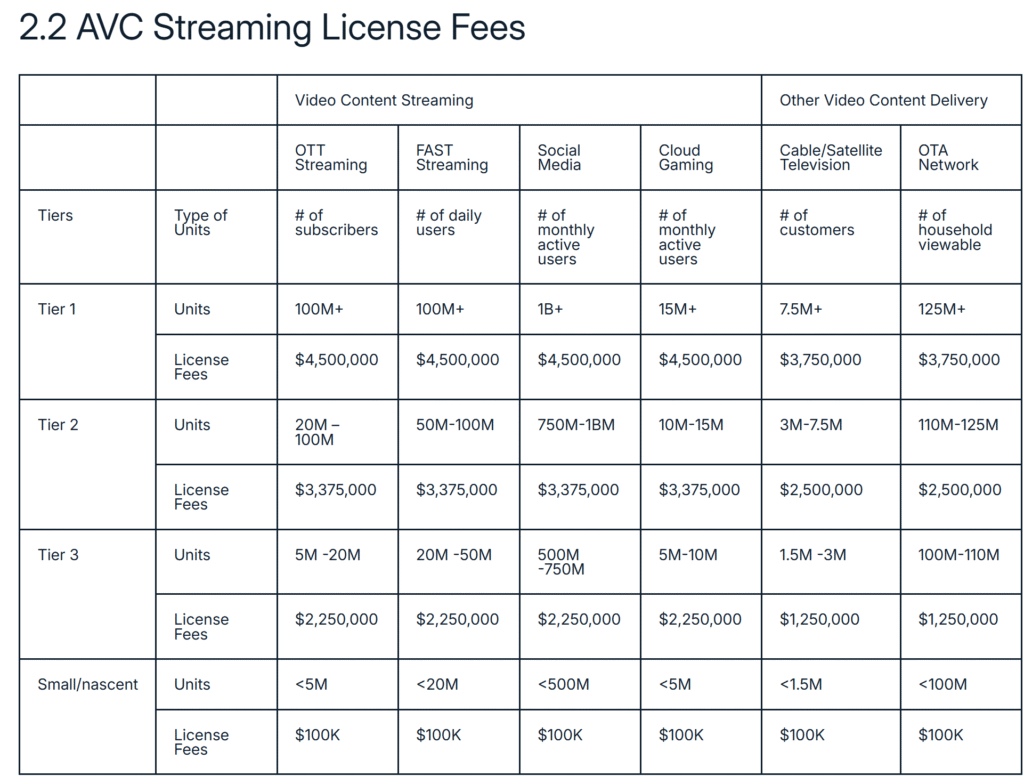
Via Licensing Alliance has updated its H.264 streaming fee structure for 2026, and the changes bring a sharp increase for large platforms while keeping smaller services under the same ceiling. The revised pricing now scales up to $4.5 million per year for major OTT, FAST, social media, and cloud gaming platforms, which signals a clear shift in how licensing costs will impact the streaming industry going forward.
The new structure keeps the $100,000 cap for small and nascent services, but it introduces tiered pricing for bigger players based on user scale and reach. Tier 1 applies to the largest services, including OTT platforms with over 100 million subscribers and social platforms with more than 1 billion monthly users, while Tier 2 and Tier 3 drop to $3.375 million and $2.25 million respectively, which still represents a major cost for companies entering the space.
Streaming Media reports that companies with an active AVC license by the end of 2025 will continue under their existing terms, which protects current licensees from the new pricing structure.
“The first and most important question is scope. Via’s response to my questions was clear on this point: all AVC licensees with an active license as of the end of 2025 were entitled to retain the streaming terms of their original agreement. The new fee structure applies only to previously unlicensed implementers seeking a license starting in 2026.” — Streaming Media
This distinction keeps existing agreements stable, but it raises the barrier for new entrants who now face significantly higher costs to license H.264 technology.
Licensing pressure spreads beyond H.264
At the same time, codec licensing pressure is no longer limited to H.264, as companies now face overlapping terms from HEVC and other standards. Nokia has already secured HEVC licensees, while Access Advance and Avanci have introduced additional codec-related licensing frameworks, which increases the financial burden on streaming platforms.
The impact has also reached the PC market, where companies like Dell and HP have reportedly disabled H.265 hardware decoding on some systems, and legal disputes in Germany forced Acer and ASUS to halt direct sales temporarily, which shows how licensing issues now affect both software services and hardware distribution.
These developments push the industry toward open standards, as companies look for ways to avoid rising costs and reduce long-term licensing risks.