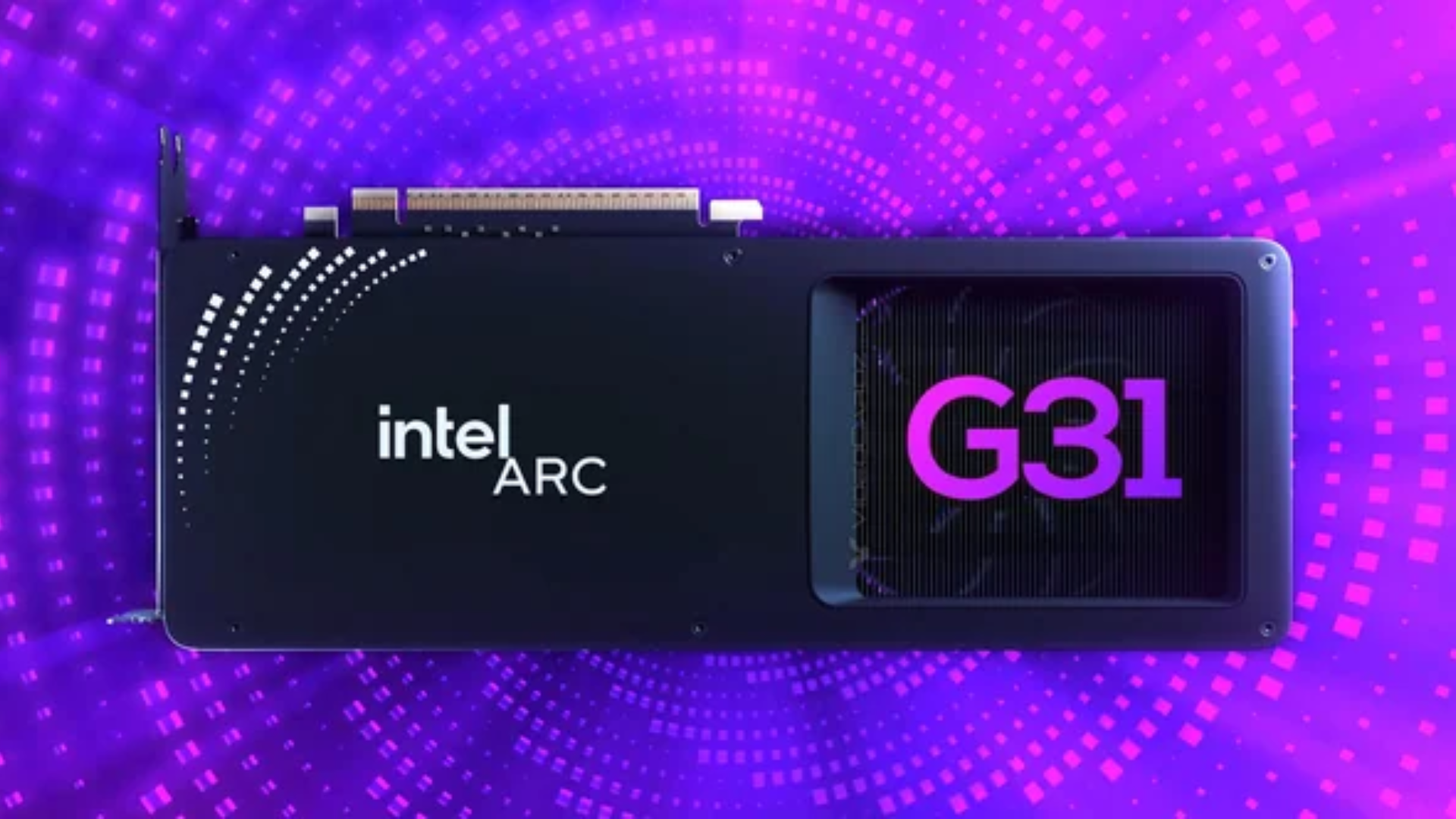

Intel has now shared the full physical details of its BMG-G31 GPU, which powers the Arc Pro B70 and Arc Pro B65 workstation graphics cards, giving a clearer picture of how its largest Battlemage chip stacks up against rivals from NVIDIA and AMD.
PC Games Hardware reports that BMG-G31 packs 27.7 billion transistors and measures 368 mm², with Intel relying on TSMC’s 5nm process for production, and this makes it a clear step up from the smaller BMG-G21 chip that comes in at 19.6 billion transistors and 272 mm².
Intel positions BMG-G31 close to competing GPUs like NVIDIA’s GB203 and AMD’s Navi 48 in terms of die size, although its use of a less dense node results in lower transistor density, which affects how much performance Intel can extract per square millimeter.
Intel BMG-G31 vs NVIDIA and AMD
| GPU | Transistors | Die Size | Process |
|---|---|---|---|
| Intel BMG-G31 | 27.7B | 368 mm² | TSMC N5 |
| NVIDIA GB203 | 45.6B | 378 mm² | TSMC N4P |
| AMD Navi 48 | 53.9B | 357 mm² | TSMC N4P |
The Arc Pro B70 uses this chip with 32 Xe2-HPG cores, 256 XMX engines, 32 RT units, and 32 GB of memory, while also offering 608 GB/s bandwidth through a 256-bit interface and support for PCIe 5.0 x16, and Intel also plans a cut-down version with fewer cores but the same memory bus.
Performance shows a clear improvement, as the B70 runs about 45 percent faster than the B60 in gaming workloads, although it still does not reach the level of competing GPUs from NVIDIA and AMD, which means pricing will play a key role in how these cards perform in the market.
Intel has not released a gaming variant of BMG-G31 yet, even though earlier expectations pointed toward models like Arc B770 or B780, and instead the company has focused on workstation GPUs with the Arc Pro B70 and B65, leaving the gaming segment open for speculation around future launches.