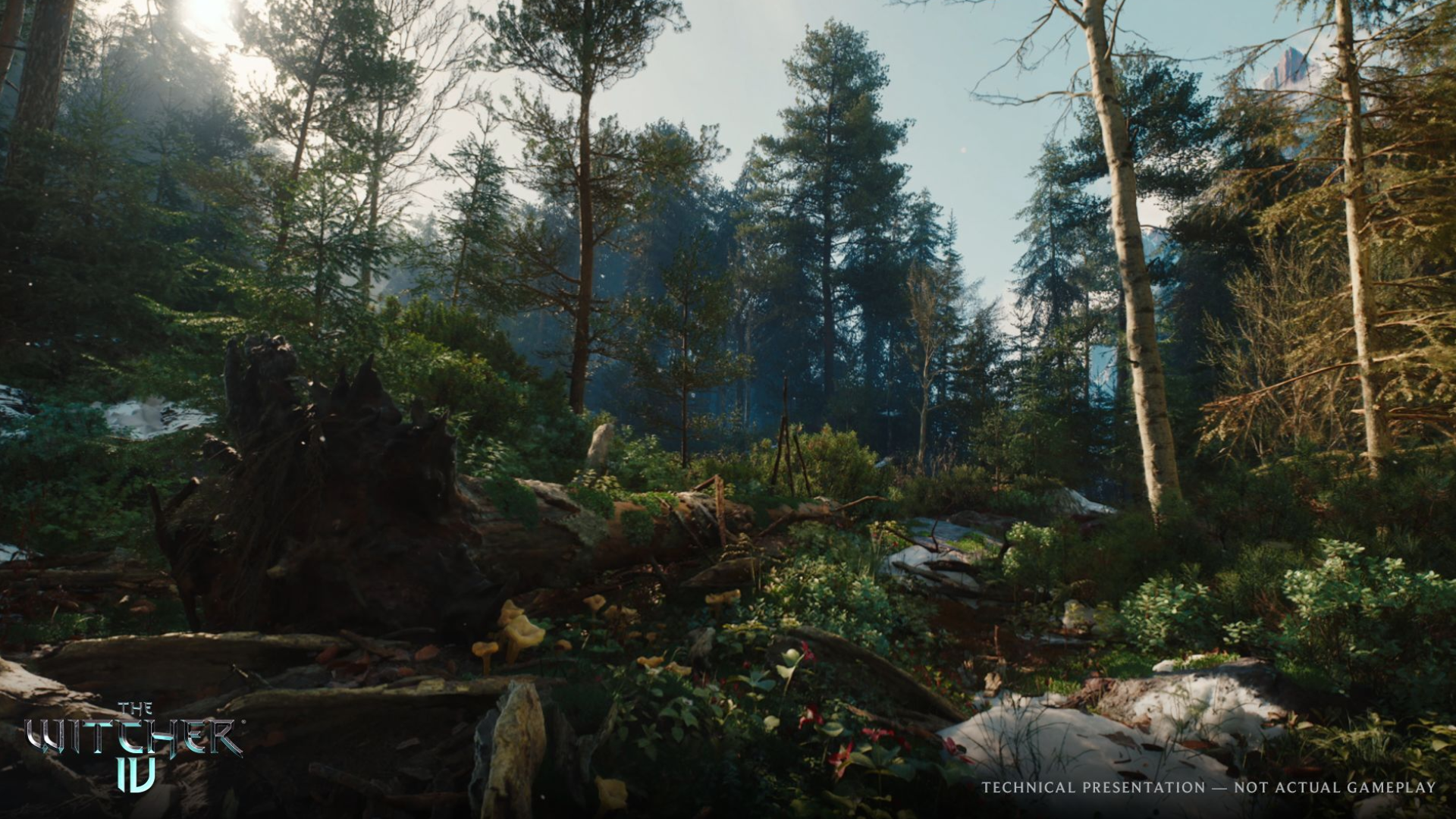

At GDC 2026, NVIDIA and CD Projekt RED showed a new look at The Witcher 4, focusing on how the game handles massive forests with path tracing, and the demo highlights a major step forward in real-time rendering as it builds entire environments using full geometry instead of shortcuts like alpha maps or cards, which gives more realistic lighting, shadows, and detail across large open-world scenes.
NVIDIA later shared a full replay of its session, where Martin Stich explained how the company built this system using RTX Mega Geometry, and the demo itself runs on a 5×5 km terrain filled with around 60 million plants, including about 1 million trees across 200 species, all loaded into memory without streaming, which removes pop-in issues and keeps the scene stable at all times.
Massive detail with new geometry system
Each tree in the demo carries extreme detail, with larger ones reaching over 10 million polygons, and every element from branches to pine needles exists as actual geometry, which allows the path tracer to calculate lighting accurately at every level.
To manage this, NVIDIA uses a system built around small reusable parts called twigs, where each tree contains a dozen base twig meshes that get instanced hundreds or thousands of times, and instead of complex vertex animation, each piece attaches to a skeleton, which keeps animation efficient while still looking natural.
Smarter LOD without losing detail
The team also developed a multi-stage level-of-detail system that reduces the number of instances as objects move further away, while keeping the geometry quality intact, and this system merges meshes progressively until a distant tree becomes a single instance, which helps control memory use without lowering visual quality.
NVIDIA solves the memory problem caused by unique merged meshes using Opacity Micro-Maps, which generate simplified versions offline and allow efficient rendering at scale, while still keeping the same underlying geometry detail.
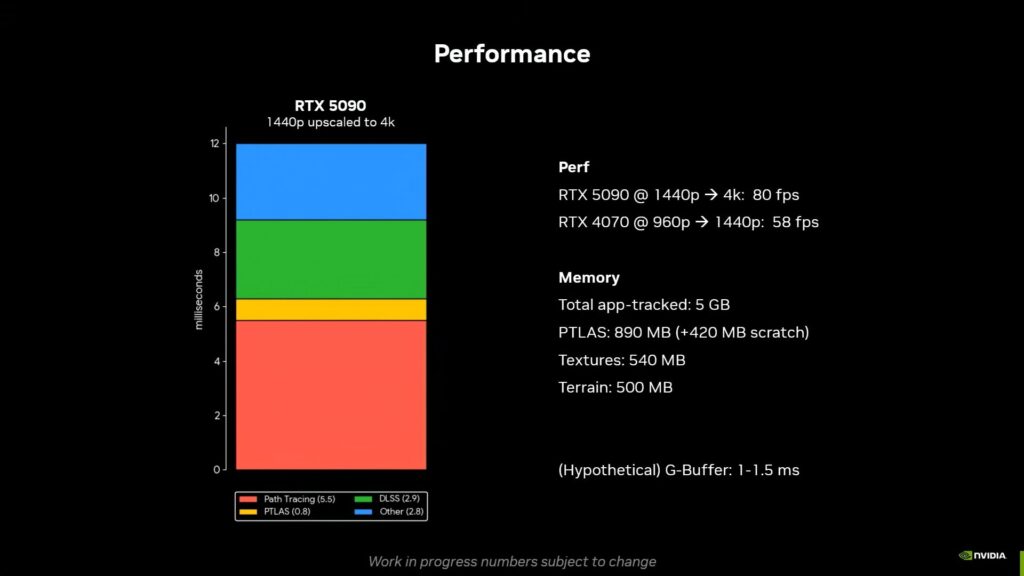
The demo runs at around 80 fps at 4K using DLSS on an RTX 5090, while an RTX 4070 delivers about 58 fps at 1440p, and most of the performance cost comes from path tracing and DLSS processing, which shows how demanding this technology still is.
The Witcher 4 is expected to launch around 2027, and while this demo reflects work-in-progress performance, it still gives a clear idea of the hardware needed, although earlier tests on PlayStation 5 running at 60 fps with ray tracing suggest the final game will scale across platforms.