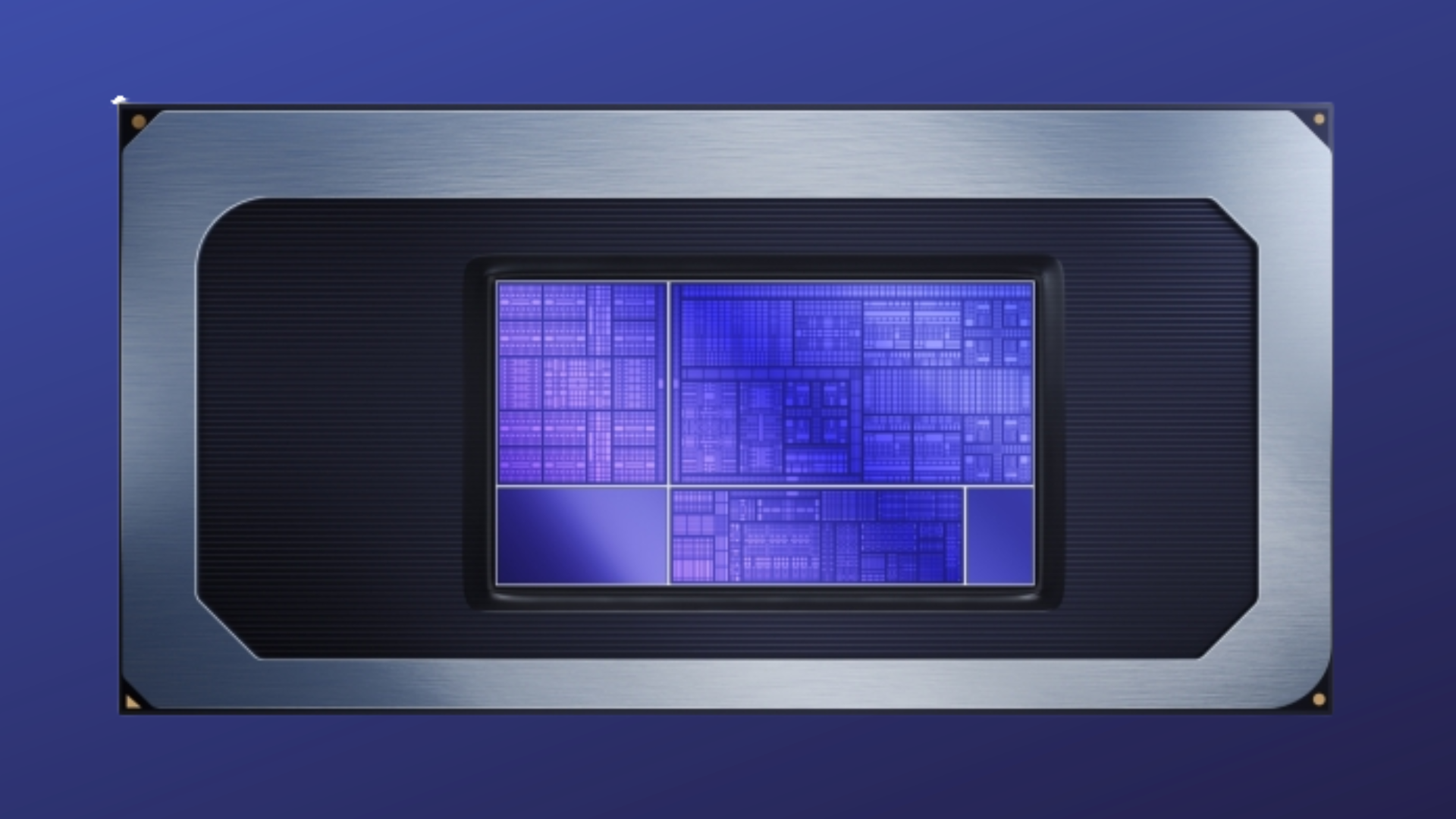

Intel’s upcoming Wildcat Lake processors have surfaced in a detailed leak that outlines core configurations, clock speeds, and power limits, giving a clear look at how the company plans to push ultra-efficient chips into a higher performance range while still targeting low-power devices. The new lineup shifts away from the ultra-low 6–7W envelope seen in earlier generations and instead operates within a broader 15–35W TDP range, which signals a strong focus on balancing efficiency with sustained performance.
According to a leak shared by @jaykihn0, Intel will introduce multiple SKUs under the Core 300 series branding, including Core 7, Core 5, and Core 3 variants, all built around a hybrid layout that combines Performance cores with Low Power Efficient cores.
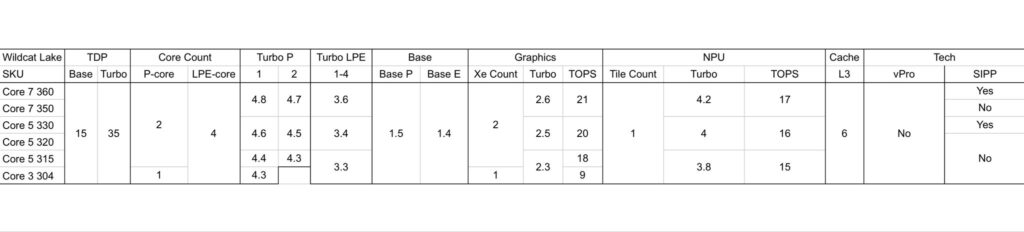
Intel is standardizing most of the lineup around a 2 P-Core + 4 LP-E core design, while the entry-level Core 3 304 uses a 1+4 configuration, which confirms earlier speculation about a lower-tier chip. The flagship Core 7 360 reaches up to 4.8 GHz boost on Performance cores and up to 3.6 GHz on LP-E cores, while base clocks remain at 1.5 GHz and 1.4 GHz respectively across all models.
At the same time, Intel has removed traditional Efficient cores from this lineup and instead relies entirely on LP-E cores, which aligns with the architecture used in Panther Lake.
Wildcat Lake integrates Xe3 graphics with up to two cores running at 2.6 GHz, while AI performance ranges between 9 and 21 TOPS depending on the SKU. The integrated NPU delivers between 15 and 17 TOPS, which is lower than Panther Lake but still suitable for lightweight AI workloads on thin devices.
Intel Wildcat Lake lineup and specs
| SKU | P-Core + LP-E | P-Core (Base/Boost) | LP-E (Base/Boost) | iGPU | NPU (TOPS) | L3 Cache | TDP |
|---|---|---|---|---|---|---|---|
| Core 7 360 | 2+4 | 1.5 / 4.8 GHz | 1.4 / 3.6 GHz | 2 cores, 2.6 GHz, 21 TOPS | 17 | 6 MB | 15–35W |
| Core 7 350 | 2+4 | 1.5 / 4.8 GHz | 1.4 / 3.6 GHz | 2 cores, 2.6 GHz, 21 TOPS | 17 | 6 MB | 15–35W |
| Core 5 330 | 2+4 | 1.5 / 4.6 GHz | 1.4 / 3.4 GHz | 2 cores, 2.5 GHz, 20 TOPS | 16 | 6 MB | 15–35W |
| Core 5 320 | 2+4 | 1.5 / 4.6 GHz | 1.4 / 3.4 GHz | 2 cores, 2.5 GHz, 20 TOPS | 16 | 6 MB | 15–35W |
| Core 5 315 | 2+4 | 1.5 / 4.4 GHz | 1.4 / 3.3 GHz | 2 cores, 2.3 GHz, 18 TOPS | 15 | 6 MB | 15–35W |
| Core 3 304 | 1+4 | 1.5 / 4.3 GHz | 1.4 / 3.3 GHz | 1 core, 2.3 GHz, 9 TOPS | 15 | 6 MB | 15–35W |
Intel is clearly increasing power limits to unlock higher sustained performance while still keeping these chips within an efficient range for thin and light systems, and the shift to LP-E cores alongside Xe3 graphics shows a tighter integration of CPU, GPU, and AI workloads for everyday computing.