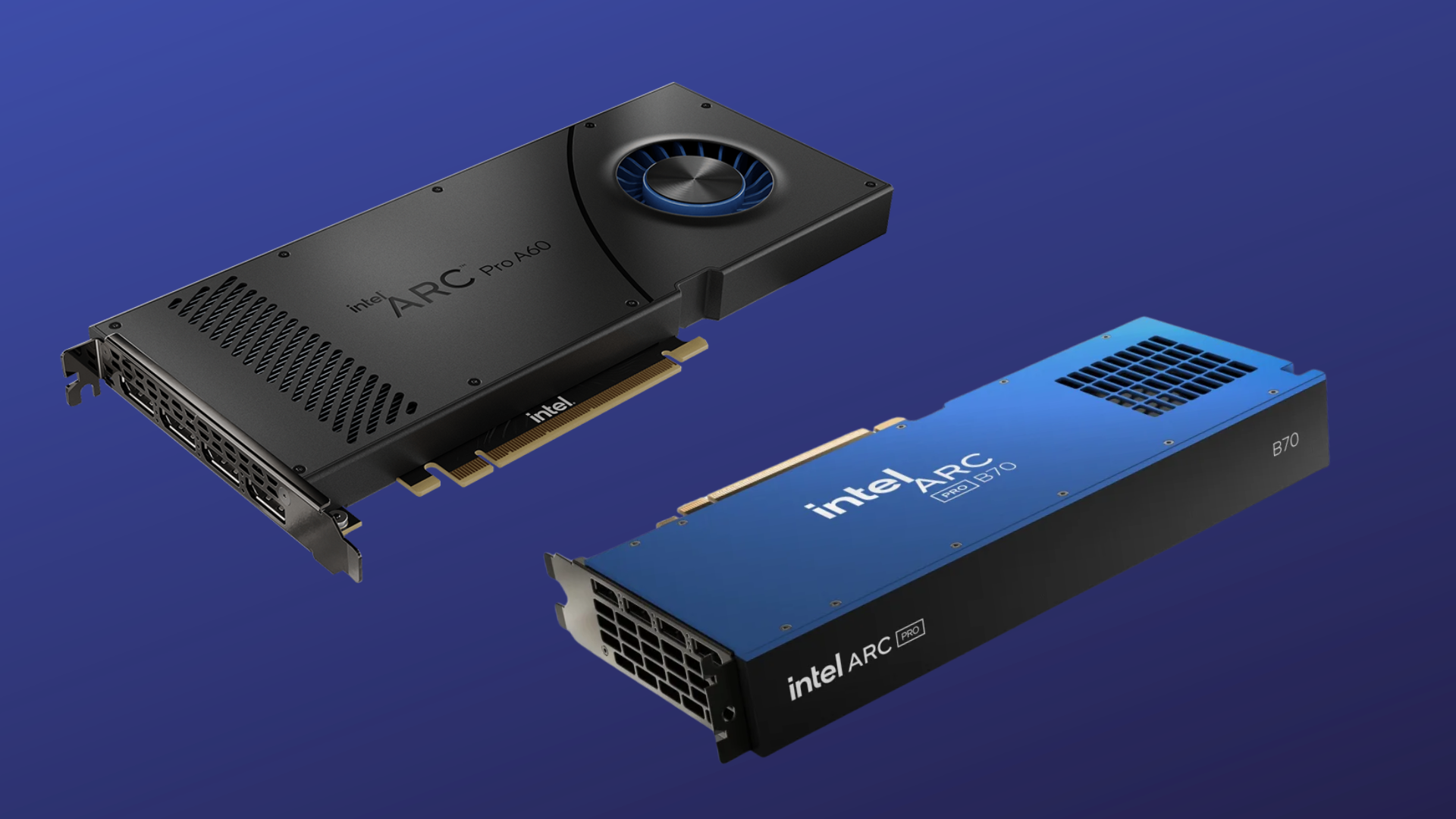

Intel has introduced two new workstation GPUs under its Arc Pro lineup, the Arc Pro B70 and Arc Pro B65, both built on the larger BMG-G31 architecture and designed to handle AI workloads, software development, and professional graphics tasks, while also pushing higher memory capacity with 32GB GDDR6 across both models.
The Arc Pro B70 leads this launch with stronger compute performance and higher throughput, while the B65 targets users who need large memory capacity without paying for peak performance, which makes this lineup clearly focused on AI inference and enterprise use instead of gaming.
Arc Pro B70 and B65
Arc Pro B70 packs 32 Xe cores and 256 XMX engines, delivering up to 367 peak TOPS with 608 GB/s memory bandwidth, and it operates within a 160W to 290W board power range, while Intel’s own variant runs at 230W and will be available starting March 25 with a starting price of $949.
Arc Pro B65 uses a trimmed configuration with 20 Xe cores and 160 XMX engines, offering up to 197 peak TOPS, and it carries the same 32GB memory but runs at 200W board power, with availability set for mid-April at a lower price point that Intel has not disclosed yet.
Performance and Positioning
Intel is focusing heavily on AI inference performance, especially on Linux systems, where the company claims the B70 delivers higher token throughput, faster response times, and better efficiency compared to competing workstation GPUs, while also improving performance in professional workloads over previous Arc Pro models.
At the same time, this launch confirms that Intel is prioritizing its Battlemage architecture for AI and workstation markets first, which puts gaming-focused variants on a later timeline.
Specifications Comparison
| Model | Xe Cores | Memory | Peak AI Performance | Board Power |
|---|---|---|---|---|
| Arc Pro B50 | 16 | 16GB GDDR6 | 170 pTOPS | 70W |
| Arc Pro B60 | 20 | 24GB GDDR6 | 197 pTOPS | 120W to 200W |
| Arc Pro B70 | 32 | 32GB GDDR6 | 367 pTOPS | 160W to 290W |
| Arc Pro B65 | 20 | 32GB GDDR6 | 197 pTOPS | 200W |
Intel is clearly targeting developers and AI workloads with this release, and the focus on high memory capacity alongside improved inference performance shows where the company sees demand growing right now.